A feasibility study is a structured analysis that tells you, before you commit serious money, whether a project can be delivered and whether it will earn enough to justify the risk. To do one step by step: define the opportunity, test real demand in the market, work out what you need technically and operationally, check the legal requirements, build a financial model with costs, revenue, break-even and payback, stress-test the numbers under bad scenarios, and then make a clear go, adjust or stop decision.
The study is not paperwork for the bank. It is the cheapest insurance an entrepreneur can buy, because every mistake you find in a spreadsheet is a mistake you do not pay for in rent, stock and salaries. Below we walk through the process using the well-known TELOS framework, then build a simple worked example so you can see how the numbers drive the decision.
What a feasibility study is, and what it is not
A feasibility study evaluates a proposed project across market, technical, financial, legal and operational dimensions to judge if it is viable. It differs from three documents people often confuse it with:
- A business plan comes after the study. The study asks "should we do this?"; the plan explains "how will we do it and grow it?"
- A pitch deck is a persuasion tool for investors. A good deck is built on a feasibility study, never instead of one.
- A market study is one component of the feasibility study, not the whole of it.
When do you need a professional study?
You can run a first-pass study yourself for a small service business. Bring in a professional when the investment is large relative to your savings, when you plan to borrow or raise equity, when the project involves licences, equipment or regulated activity (food, health, manufacturing, education), or when several partners need an objective basis for splitting equity.
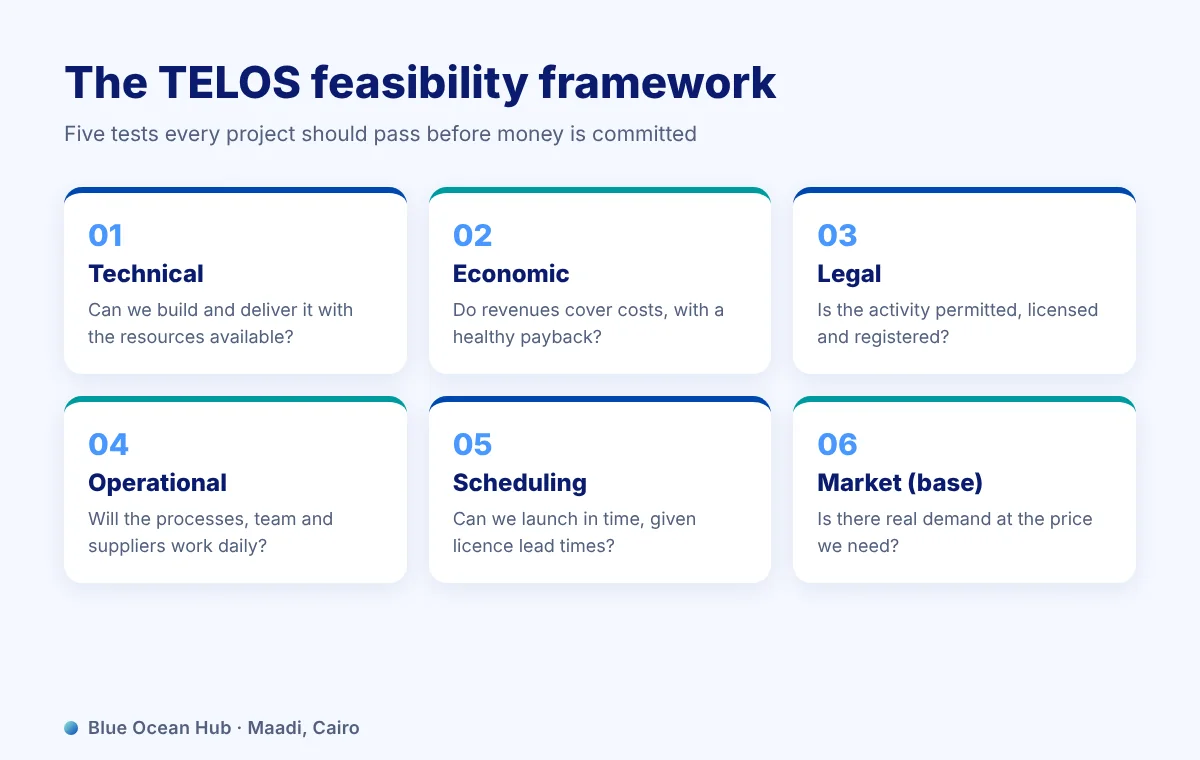
The TELOS framework: five tests of viability
Most frameworks also add a market test, which sits underneath the economic one because every revenue figure depends on it. We start there.
Step 1: Prove the market
Market feasibility answers: is there enough demand, from whom, at what price? Work through it in this order:
- Define the customer precisely: who they are, where they are, what problem they pay to solve and how they solve it today.
- Size the market realistically. Start from the customers you can actually reach in year one, not the whole of Egypt.
- Map competitors, direct and indirect, with their prices, strengths and weaknesses. Visit them, order from them, read their reviews.
- Test willingness to pay with pre-orders, a landing page, a pilot or customer interviews. Real behaviour beats survey answers.
- Set price and channel based on the evidence, not on what you hope customers will pay.
Step 2: Technical and operational feasibility
List everything required to deliver the product or service at the quality you promise: premises, equipment, software, raw materials, suppliers, staff and processes. Then estimate capacity: how many units, orders or clients you can serve per month with that setup. For service and digital businesses, the biggest variables are usually the workspace and the team. That is why many founders start from a coworking space in Maadi or a furnished office for rent instead of fitting out their own premises: it turns a large upfront cost into a flexible monthly one.
Step 3: Legal feasibility
Confirm the activity is permitted where you plan to operate, list the licences and approvals required, choose the legal form and plan tax registration. Timing matters here: licence lead times can push your launch back by months, which affects cash flow. Our guide to company formation in Egypt covers entity types, documents and fees.
Step 4: Economic feasibility, with a worked example
Consider a healthy meal-prep delivery business in New Cairo selling weekly subscriptions to office workers. The figures below are illustrative only; costs and prices in Egypt move quickly, so use your own quotes. The method is what matters.
Investment costs (one-off)
- Kitchen equipment and fit-out: EGP 220,000
- Packaging stock, branding and website: EGP 40,000
- Licences, legal and setup fees: EGP 25,000
- Working capital reserve (3 months of fixed costs): EGP 195,000
- Total initial capital: EGP 480,000
Monthly fixed costs
- Kitchen rent and utilities: EGP 28,000
- Two cooks and a delivery coordinator: EGP 27,000
- Marketing: EGP 10,000
- Total fixed costs: EGP 65,000 per month
Unit economics
A weekly subscription (10 meals) sells for EGP 1,500. Ingredients, packaging and delivery cost EGP 900 per subscription, leaving a contribution margin of EGP 600.
Break-even
Break-even = fixed costs ÷ contribution per unit = 65,000 ÷ 600 ≈ 109 weekly subscriptions a month, roughly 27 active subscribers every week.
Base-case profit and payback
If the business averages 45 subscribers a week (about 180 subscriptions a month), monthly contribution is 180 × 600 = EGP 108,000. After fixed costs, operating profit is about EGP 43,000 a month before tax. Excluding the working-capital reserve, the EGP 285,000 spent on setup is recovered in roughly 6.6 months.
Step 5: Stress-test before you decide
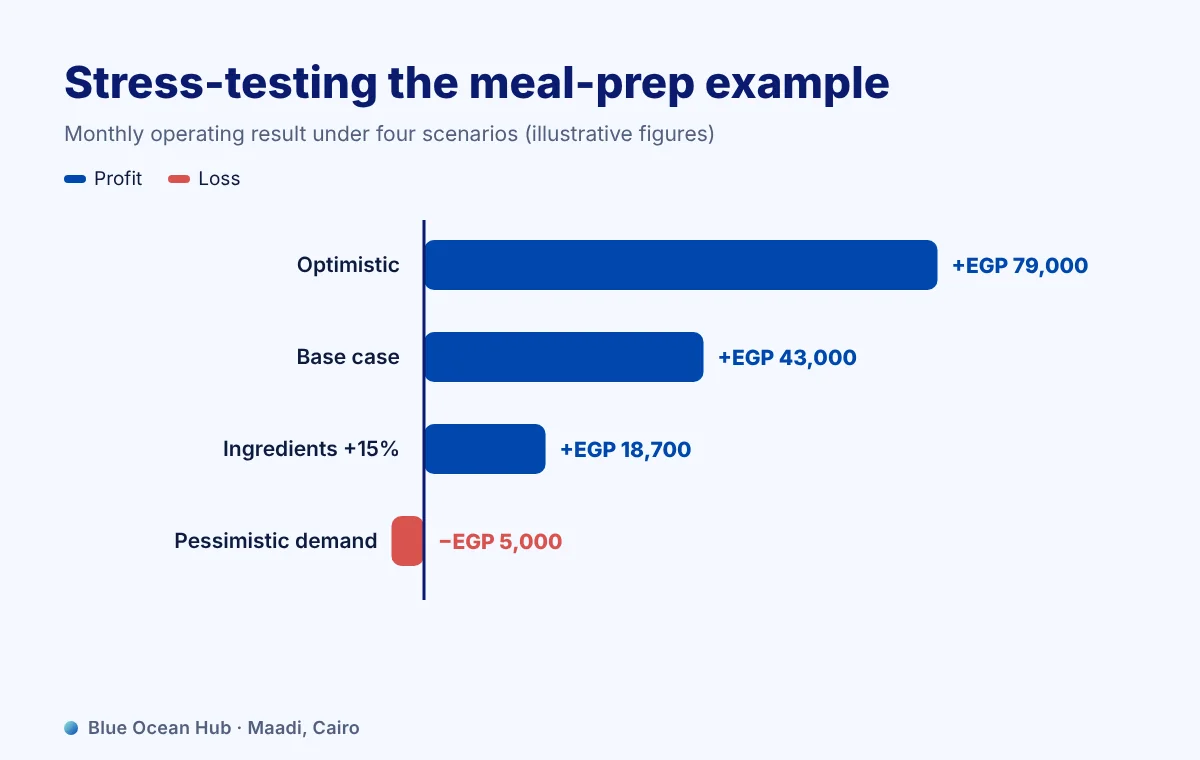
A study that only shows the base case is a sales document. Run a sensitivity table:
What the table tells you: the idea works, but margins are sensitive to ingredient costs, and the business loses money below about 27 subscribers a week. Sensible responses include building a price-review clause into subscriptions, negotiating fixed supplier prices for three months, and keeping the three-month cash reserve untouched until subscribers pass 30. The study has not just said "go"; it has shaped how to go.
Step 6: Make the decision
End the study with a one-page conclusion: go, go with changes, or stop. List the assumptions that must hold for success, the early-warning indicators you will track monthly, and the point at which you would change course. Once you decide to go, the next document is your business plan, and the next challenge is execution, which our article on closing the strategy-execution gap addresses.
Common mistakes that make a study worthless
- Optimistic sales curves. New businesses ramp slower than founders expect.
- Forgetting working capital. Many profitable projects die because cash runs out before break-even.
- Hidden costs. Social insurance, taxes, licence renewals, maintenance, payment-gateway fees.
- Ignoring currency and inflation risk. In Egypt, test what happens if imported inputs rise sharply.
- Using a downloaded template study. Numbers from another city or year do not describe your project.
How much does a feasibility study cost in Egypt?
Prices vary widely with scope. A first-pass study for a small service business is a very different job from a bankable study for a factory needing technical, environmental and financing analysis. Ask any provider for a written scope: does it include real field research, an editable financial model and sensitivity scenarios? A cheap, recycled study can become the most expensive document you ever buy if you base a decision on it.
Frequently asked questions
What is a feasibility study?
An analysis of a project's market, technical, financial, legal and operational viability, carried out before implementation to decide whether it is worth pursuing.
How do I do a feasibility study for a small business?
Define the customer, validate demand and price, list the resources required, check legal requirements, model costs and revenue, calculate break-even and payback, and test a pessimistic scenario before deciding.
What are the main elements of a feasibility study?
Market, technical, economic or financial, legal, operational and scheduling feasibility, plus a risk assessment.
What is the difference between a feasibility study and a business plan?
The feasibility study decides whether to proceed; the business plan describes how to execute and grow once the decision is made.
How long does a feasibility study take?
A simple study for a small service business can take one to three weeks; larger projects with field research and technical analysis take longer.
Can I do a feasibility study myself?
Yes for small projects, using the steps above. Have it reviewed by a specialist if the investment is large or you will seek financing.
From idea to a viable company with Blue Ocean Hub
Blue Ocean Hub in Maadi supports founders from the first spreadsheet to a running company. Our business setup and growth consulting team reviews feasibility studies and financial models, advises on the right legal structure and handles company setup, while flexible membership plans, private offices and training rooms keep your fixed costs low during the riskiest months. New to building a business? Read our guide to entrepreneurship. Contact us to talk through your idea.