
Setting up a company in Egypt follows a clear path: choose the legal form, reserve the trade name, draft the articles of association, deposit capital where required, secure a registered office with a valid lease, file with the General Authority for Investment and Free Zones (GAFI) online or at an Investor Service Centre, then collect your commercial register and tax card and complete post-incorporation registrations. Government fees depend mainly on the company type and its capital; on top of them come legal and accounting fees and, often the biggest item, the cost of your office.
This guide is written for local founders and for foreign entrepreneurs relocating to Cairo. It explains which entity fits which situation, the documents you need, a realistic timeline, the main cost lines, the tax registrations that follow, and how a virtual office can serve as your registered address while you are still small.
Important: fees and procedures in Egypt are updated by regulation from time to time. Treat the figures here as orientation and confirm current values with GAFI or your adviser before filing.
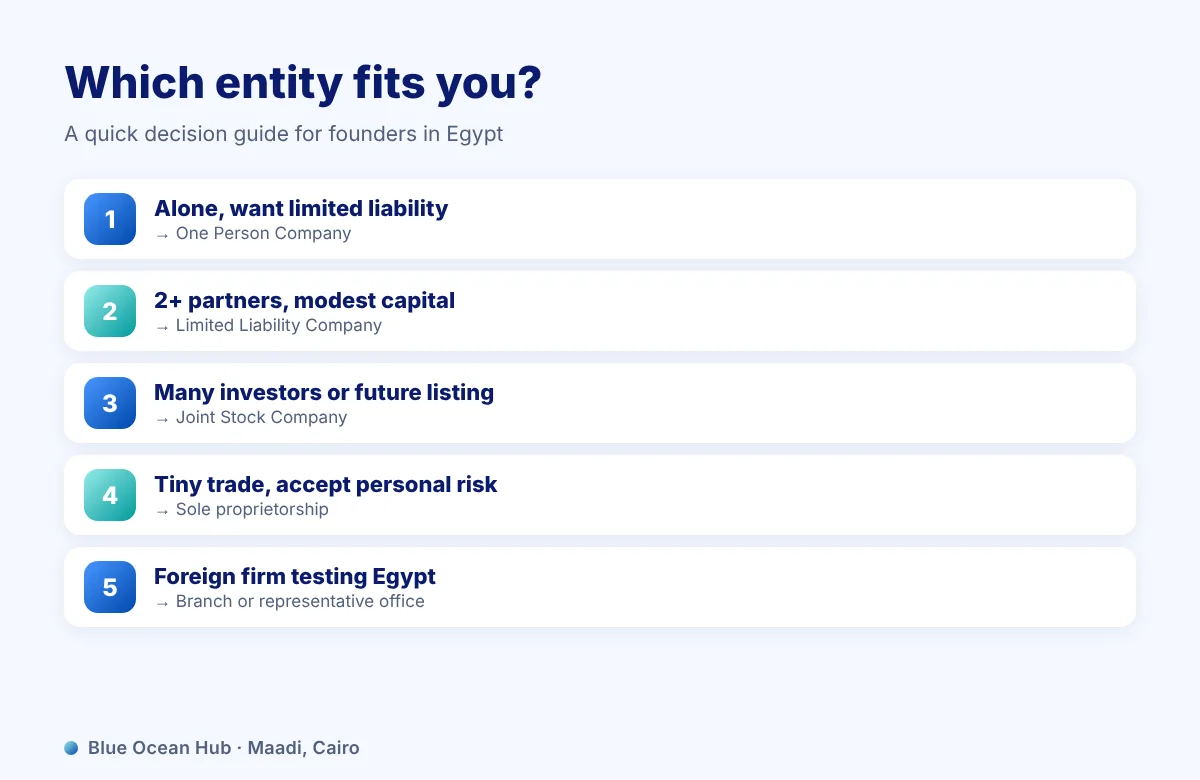
Which entity should you choose? A quick decision guide
- You are alone and want limited liability: a One Person Company (OPC).
- You have two or more partners and want flexibility with modest capital: a Limited Liability Company (LLC), the most common choice for startups and SMEs.
- You plan several investment rounds, many shareholders or a future listing: a Joint Stock Company (JSC).
- You run a very small trading activity and accept personal liability: a sole proprietorship.
- You are a foreign company testing the market: a branch or representative office, depending on whether you will trade locally.
Entity comparison
The OPC was introduced through 2018 amendments to the Companies Law, letting a single founder separate personal and business assets without a nominal partner. The LLC remains the workhorse for small and medium businesses. The JSC suits companies that will issue new shares to investors, but it brings heavier governance duties, covered in our guide to corporate governance.
The incorporation process, step by step
1. Reserve the trade name
Submit one or more proposed names and obtain a certificate confirming the name does not conflict with an existing registration. Check that the matching domain and social handles are free before you commit.
2. Draft the articles of association
The articles set out the company's name, objects, capital, ownership, management and profit distribution. Draft the objects broadly enough to cover related activities you may add later. Alongside the official articles, sign a private shareholders' agreement covering vesting, exits, deadlock and new investors.
3. Deposit capital where required
Some forms, notably the OPC and the JSC, require capital to be deposited in a bank account under incorporation and a bank certificate to be filed.
4. Secure a registered office
You need a lease or ownership document for the company's headquarters, usually notarised or registered. This is where many founders overspend, signing a long lease on an empty office before the business has revenue. A virtual office or a flexible private office with a lease suitable for incorporation is often the smarter start.
5. File with GAFI
Applications can be submitted through GAFI's electronic services or at an Investor Service Centre, where the relevant authorities sit under one roof. Partners' signatures are authenticated, documents reviewed and fees paid.
6. Receive your commercial register and tax card
Once approved, the company is entered in the commercial register, gains legal personality and receives its tax card and incorporation documents.
7. Complete post-incorporation registrations
- Open a corporate bank account.
- Register for VAT once taxable sales exceed the registration threshold (EGP 500,000 a year at the time of writing) or if your activity requires it. The standard VAT rate is 14%.
- Join the e-invoice and e-receipt systems.
- Register with social insurance when you hire your first employee.
- Obtain sector licences and join the relevant chamber or federation.
Documents checklist
- National IDs for Egyptian partners and managers; passports for foreign partners
- Trade-name non-conflict certificate
- Articles of association
- Lease or title for the registered office
- Bank certificate of capital deposit, where required
- Power of attorney for whoever handles the filing
- Auditor details for certain entity types
- Prior approvals for regulated activities
Notes for foreign founders
Foreign ownership of up to 100% is permitted in most activities, with restrictions in certain sectors and locations. Foreign partners usually face additional steps such as document legalisation and security clearance, which can extend the timeline. Plan residence and work permits for foreign managers separately; they are not issued automatically with incorporation.
What does it cost?
There is no single figure, because several government fees are a percentage of capital with a floor and a cap. The main cost lines are:
Build all of these into your feasibility study from day one, together with the corporate income tax that will apply to profits (the standard rate is 22.5%).
How long does it take?
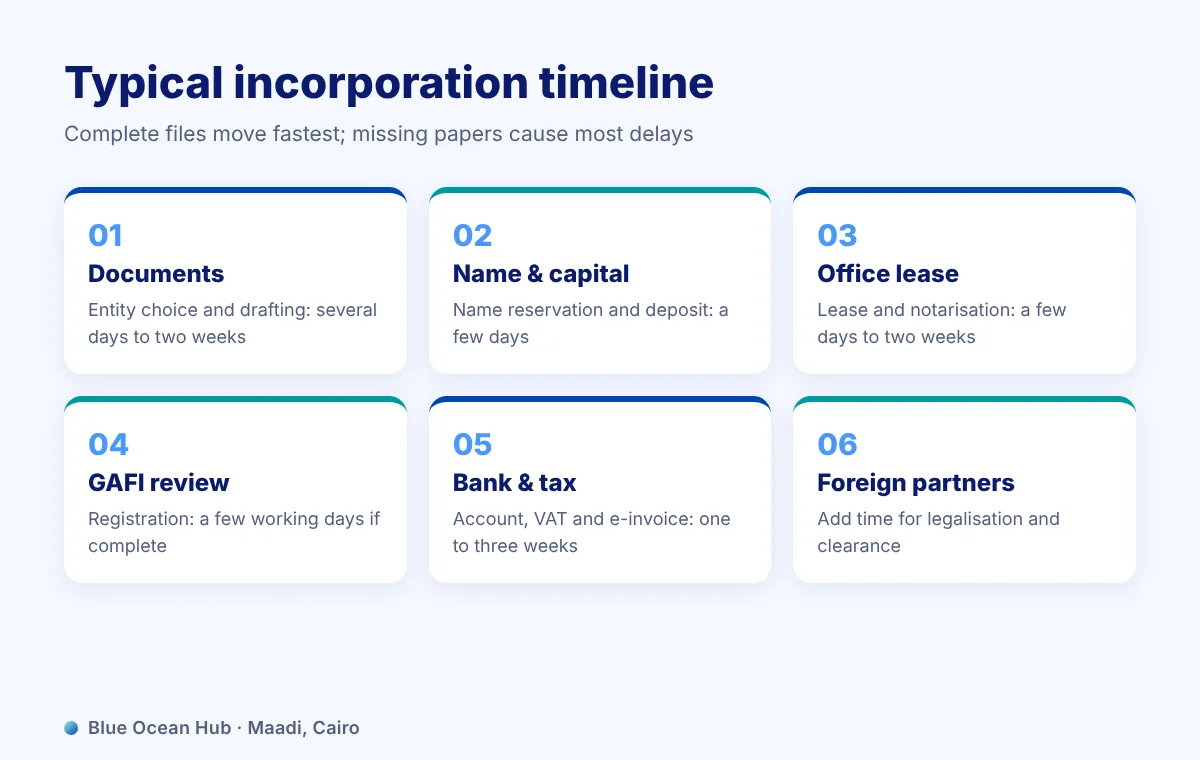
The most common delays are missing documents, a rejected name, an office lease that does not meet requirements, and activities needing approval from another authority. Foreign shareholders should add time for legalisation and clearance.
Can you register your company at a virtual office address?
In many cases, yes. If your activity does not require special premises such as a factory, warehouse or clinic, you can use a virtual office as your registered address, provided you hold a lease that satisfies incorporation requirements. You gain a professional business address, mail handling and access to meeting rooms for client meetings, at a fraction of the cost of a conventional office. Read more in What Is a Virtual Office?
At Blue Ocean Hub in Maadi, our business setup and growth consulting service covers GAFI procedures, commercial registration, tax card issuance and certified lease agreements, while our virtual offices, private offices and coworking space give you a ready address from the first day.
Mistakes to avoid
- Choosing the cheapest form without thinking about liability. A sole proprietorship exposes your personal assets.
- Writing narrow company objects. You will pay to amend the articles later.
- Skipping the shareholders' agreement. The official articles rarely cover exits and deadlocks.
- Signing a big lease too early. It drains cash in the months that matter most.
- Ignoring post-incorporation compliance. Missed tax filings and e-invoicing obligations lead to penalties.
Frequently asked questions
What are the steps to set up a company in Egypt?
Choose the entity, reserve the name, draft the articles, deposit capital if required, secure an office lease, file with GAFI, then receive the commercial register and tax card and complete VAT, e-invoice and social insurance registrations.
How much does company formation in Egypt cost?
Government fees are partly a percentage of capital with minimums and caps, plus professional fees and office costs, so the total varies by entity and capital. Request an itemised quote before starting.
Can a foreigner own 100% of a company in Egypt?
In most activities yes, although some sectors and locations carry restrictions, and foreign partners face extra steps such as legalisation and security clearance.
How long does it take to register an LLC?
GAFI can complete registration within a few working days for a complete file, but the full journey to an operating bank account usually takes from several days to a few weeks.
Can I register a company online in Egypt?
GAFI offers electronic incorporation services for several entity types, although some steps, such as signature authentication and collecting documents, still require attendance.
Can I use a virtual office as my registered address?
Yes for most non-industrial activities, provided your lease meets incorporation requirements.
Incorporate and set up your base in one place
Instead of juggling a law firm, an estate agent and an accountant, let Blue Ocean Hub handle company setup and give you a professional base in Maadi. Once you are registered, read our guide to governance to build the company on clear rules from day one. Contact us for a clear incorporation plan with costs and timeline.