Governance is the system of rules, relationships and processes that decides who makes decisions in an organisation, how those decisions are made, and who holds the decision-makers to account. Good governance makes sure an organisation is run transparently and fairly, that power always comes with responsibility, and that the interests of owners, employees, customers and lenders are protected. Put simply: management runs the business day to day, while governance sets the guardrails that keep management moving in the right direction.
Many founders in Egypt hear the word and assume it belongs to banks and listed companies. It does not. The moment a business has more than one owner, outside money or a team that makes decisions without the founder in the room, it already needs some form of governance. This guide explains what governance means, where the idea came from, the principles every framework shares, why it matters commercially, and how to put it into practice without drowning your company in paperwork.
Governance in one sentence, and in plain English
The most widely quoted definition comes from the Cadbury Report published in the UK in 1992: governance is "the system by which companies are directed and controlled." The OECD expands this into a set of relationships between a company's management, its board, its shareholders and other stakeholders, which provides the structure for setting objectives, deciding how to reach them and monitoring performance.
In everyday terms, governance answers questions such as:
- Which decisions can the general manager take alone, and which need the partners or the board?
- Who can sign a contract worth EGP 500,000, and does it need a second signature?
- How are profits distributed, and what happens if a partner wants to leave?
- Who checks the accounts, and how often?
- What happens when a manager has a personal interest in a deal?
When the answers are written down, known by everyone and actually followed, the organisation has governance. When they live only in the founder's head, it does not, however well the business seems to be doing.
Where the idea came from
Governance became a serious discipline once ownership and control split apart. In a large company, shareholders own the business but do not run it, while executives run it but do not own it. Economists call the resulting tension the agency problem: the risk that managers act in their own interest rather than the owners'.
A series of milestones shaped the modern framework:
In Egypt, the Egyptian Institute of Directors, which operates under the Financial Regulatory Authority, has long led awareness and board training, and listed companies, banks and insurers face specific governance rules from their regulators.
Governance vs management: not the same job
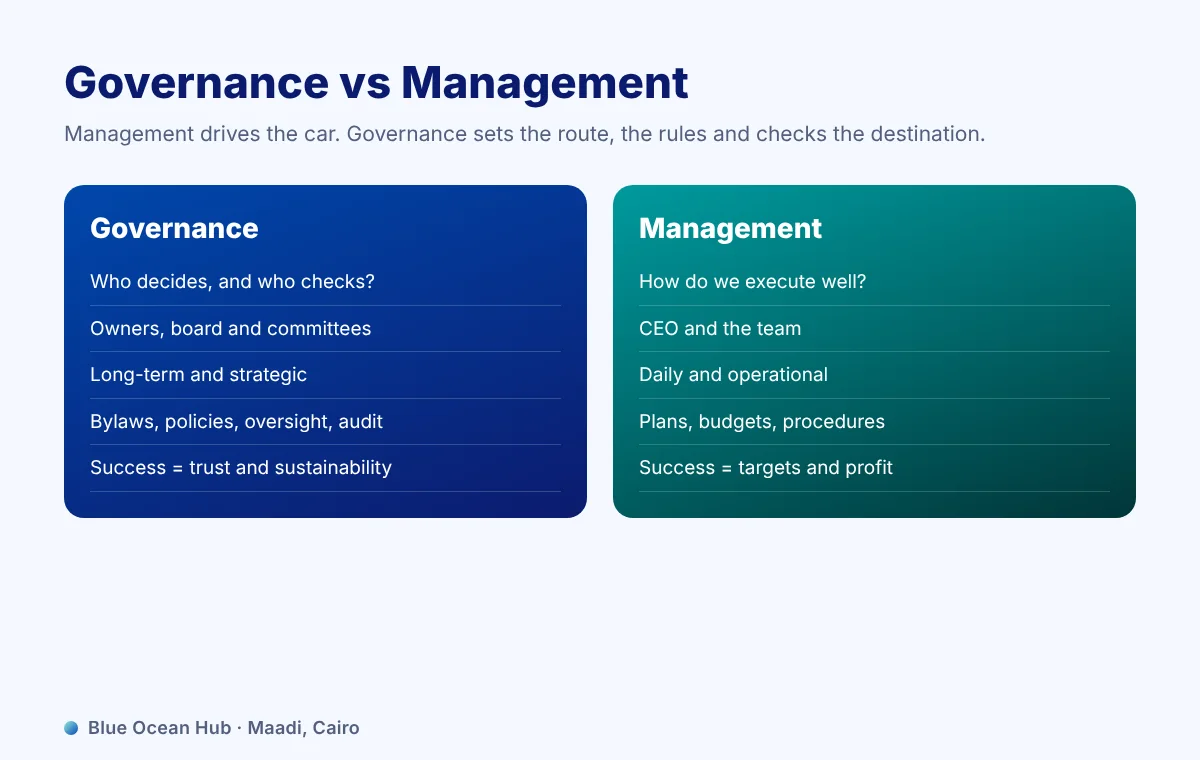
The quickest way to understand governance is to separate it from management. A useful image is a car: management is the driver, governance is the route, the rules of the road and the person checking the destination.
- Focus: management asks "how do we execute well?"; governance asks "are we doing the right thing, the right way, and who verifies it?"
- Who: management is the CEO and the team; governance sits with owners, the board and its committees.
- Time horizon: management is daily and operational; governance is long-term and strategic.
- Tools: management uses plans, budgets and procedures; governance uses bylaws, policies, oversight and audit.
- Success looks like: management delivers targets and profit; governance delivers trust, sustainability and protected rights.
Example: deciding to open a second branch in Alexandria is a governance decision because it commits the partners' capital and changes strategy. Choosing the premises, hiring the branch manager and planning the launch are management tasks. When one person does both with no check, risk grows, even if that person is honest and capable.
The four principles every framework shares
Different codes word them differently, but almost all of them come back to four ideas.
Transparency and disclosure
The people entitled to information receive it, accurately and on time: financial statements, major decisions, ownership structure, key risks and related-party transactions. Transparency does not mean publishing everything; it means never hiding something material from a partner, investor or regulator who needs it.
Accountability
Every authority has a matching responsibility, and every decision-maker answers to someone. Executives report to the board, and the board reports to shareholders. Without accountability, authority quietly turns into privilege and mistakes grow before anyone can correct them.
Responsibility
Roles and limits are clearly defined so that the board does not micromanage and managers do not act beyond their mandate. Responsibility also extends outward, to compliance with the law and to the company's impact on its community.
Fairness
All shareholders, including minority partners, are treated equitably, and stakeholders such as employees, suppliers and lenders have their rights respected. In practice this means equal access to information, a clear conflict-of-interest policy and no one using inside information for personal gain.
What governance actually does for a business
Governance is often sold as compliance. Its real value is commercial.
- Better decisions. Major choices are tested by more than one view and backed by reliable data, which reduces costly impulsive moves. If your plans keep stalling between the slide deck and reality, our piece on the strategy-execution gap shows how oversight helps close it.
- Easier access to capital. Investors and banks look first at audited accounts, a shareholders' agreement and a clear decision process. A governed company passes due diligence faster. See our field guide to raising your first $250K in Egypt.
- Lower risk. Segregation of duties, internal controls and independent audit make errors and fraud harder to commit and easier to catch.
- Continuity. Documented processes and succession plans let the company survive a founder stepping back or a partner leaving, a common breaking point for family firms.
- Trust. Employees stay longer when promotions follow published criteria; clients stay longer when complaints follow a clear path.
The many faces of governance
The term now covers several fields beyond the classic boardroom:
- Corporate governance governs the relationship between shareholders, the board and management. We cover it in depth in Corporate Governance: A Practical Guide for Startups and Family Businesses.
- Public-sector governance focuses on transparency in public spending and service quality.
- IT governance ensures technology spending supports business goals and that data is secure.
- Non-profit governance ensures donations reach their purpose and that trustees provide real oversight.
- Data and AI governance sets rules for collecting and using data and for keeping automated decisions fair and explainable.
A starter governance kit for growing companies
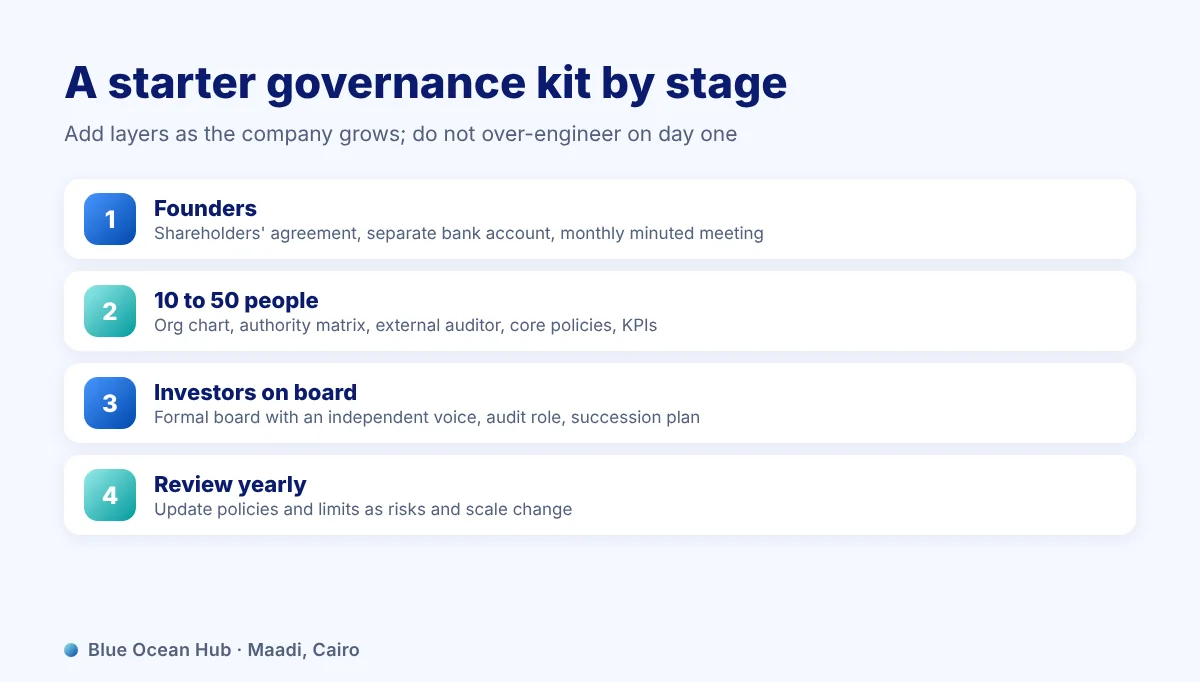
You do not need five committees and a 200-page manual. Start with the essentials and add layers as you grow.
Stage 1: founders and first hires
- A signed shareholders' agreement covering equity, roles, vesting, exits and dispute resolution.
- A company bank account fully separate from personal money.
- A monthly partners' meeting with an agenda and written minutes.
Stage 2: a team of 10 to 50
- An organisation chart and job descriptions, as discussed in business management systems.
- A delegation-of-authority matrix with spending limits and dual signatures above a threshold.
- An external auditor and a handful of KPIs reviewed every month.
- Core policies: conflict of interest, procurement, HR and data protection.
Stage 3: investors on board or expansion plans
- A formal board, ideally with at least one independent or advisory member.
- An audit or risk function, even if part-time.
- Annual review of policies and a documented succession plan. If expansion is on the table, check our business expansion readiness guide first.
Mistakes that turn governance into paperwork
- Copy-pasting templates. Bylaws that do not fit your business will never be followed.
- Box-ticking meetings. Minutes written after decisions were already made elsewhere add risk instead of reducing it.
- Over-engineering too early. A ten-person company needs clear authority and regular meetings, not a committee structure.
- Founders exempting themselves. If the founder bypasses the rules, nobody else will respect them.
Frequently asked questions
What is governance in simple terms?
It is the set of rules that decides who can decide what in an organisation, within which limits, and how everyone is held accountable.
What are the main principles of governance?
Transparency and disclosure, accountability, responsibility, and fairness to shareholders and stakeholders.
What is the difference between governance and management?
Management executes the daily work and hits targets; governance sets direction, limits and oversight so that management works in the organisation's best interest.
Do small businesses need governance?
Yes, at the right size. A shareholders' agreement, a separate bank account and documented monthly meetings prevent most of the disputes that break small companies.
What are the objectives of governance?
Better decisions, easier access to finance, lower risk and fraud, business continuity, and trust among investors, staff and customers.
How do you implement governance in a company?
Define the structure and authority levels, document the partners' agreement, hold minuted meetings, separate finances and appoint an auditor, write core policies, and review KPIs and policies regularly.
Build your governance framework with Blue Ocean Hub
Blue Ocean Hub in Maadi combines a professional base with practical advice. Our business setup and growth consulting team designs organisation structures, internal policies, governance frameworks and KPI systems sized to your stage, while our private offices and meeting rooms give you the right setting for partner and board meetings. If you are still at the idea stage, start with a solid feasibility study and the right legal form when setting up your company in Egypt. Contact us to book an introductory session.