Corporate governance is the framework that defines how a company is directed and controlled: how power is shared between shareholders, the board and management, how decisions are approved, how performance is monitored, and how the rights of partners and stakeholders are protected. For a startup or family business, applying it does not mean copying a listed company's rulebook. It means putting five building blocks in place: a written shareholders' agreement, a clear structure with defined authority, regular minuted board or partner meetings, financial controls with an independent audit, and a short list of KPIs reviewed on a schedule.
If you want the broader concept first, read What Is Governance?. This guide is the practical companion. It walks through a realistic scenario, explains how the board and committees should work, summarises the Egyptian framework, deals with the special challenges of family firms and startups, and ends with a 90-day plan and a scorecard you can use this week.
A scenario most founders will recognise
Three friends start a digital agency in Cairo. Ahmed owns 40% and handles sales, Mona owns 35% and runs delivery, and Karim owns 25% and invested most of the cash but works elsewhere. Year one goes well. In year two, Ahmed signs a large retainer at a heavy discount without telling the others, Mona hires two senior people on salaries Karim considers excessive, and Karim asks for a dividend the business cannot afford. Nobody is dishonest. There are simply no agreed rules on who decides what.
That is a corporate governance problem, and it is how most promising small companies in Egypt break up. Corporate governance answers in advance the questions that later become arguments:
- Which decisions need all partners, a majority, or just the managing partner?
- What is the spending or discount limit for each role?
- How and when are profits distributed or reinvested?
- How is a non-executive investor kept informed?
- What happens if a partner wants to sell, stops working or passes away?
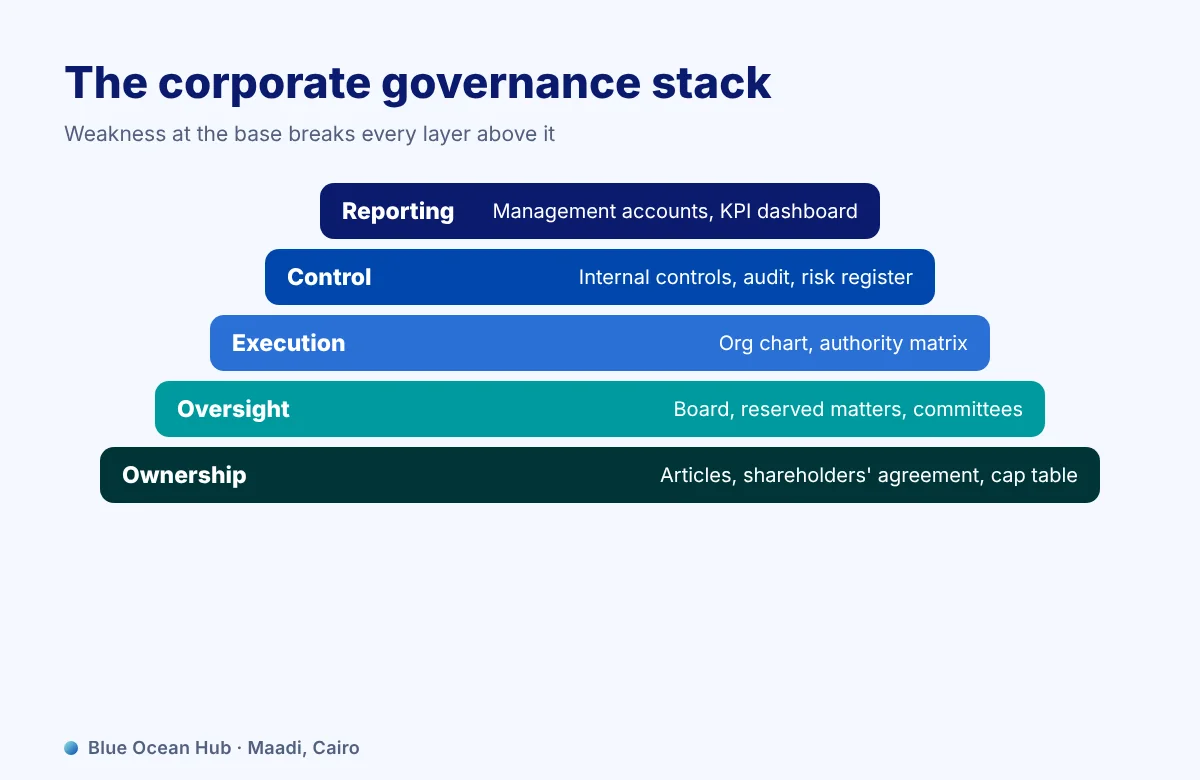
The governance stack: five layers that work together
Think of corporate governance as a stack where each layer supports the one above it.
Weakness at the bottom breaks everything above it. A beautiful KPI dashboard is useless if nobody agrees who owns the company or who can sign a contract.
How the board should actually work
The board's real job
A board does not run the business. Its core responsibilities are to approve strategy and the annual budget, appoint, support and evaluate the CEO, oversee risk and internal controls, make sure financial statements are reliable, and protect the interests of all shareholders. A board that spends its meetings discussing the office printer is a management meeting in disguise.
Composition
- Size: three to seven members is usually enough for a private company.
- Independence: at least one member with no financial or family tie to management adds an objective voice.
- Skills mix: finance, the company's industry, legal or regulatory knowledge, and growth experience.
- Chair vs CEO: separating the two roles, where possible, avoids one person marking their own homework.
Committees
The audit committee is the most important. It reviews financial statements before approval, oversees internal and external auditors, and checks that controls prevent error and fraud. Larger companies add a nomination and remuneration committee for senior appointments and pay, and a risk committee. A small company can assign the audit role to a non-executive partner or outside adviser who reviews the numbers every quarter.
Reserved matters
List the decisions that always go to the board or shareholders, for example: borrowing above a threshold, selling major assets, issuing new shares, entering a new market, appointing or removing senior managers, and transactions with related parties. Everything else is delegated to management, in writing.
Internal and external governance mechanisms
Internal mechanisms are the tools the company controls: the board, committees, bylaws and policies, the delegation matrix, internal audit and management reporting. External mechanisms are pressures from outside: the external auditor's opinion, regulators and company law, lenders' covenants, investors' information rights and, ultimately, the market, which punishes companies that lose the trust of customers and partners. Strong companies use the internal set so well that the external set rarely finds surprises.
The Egyptian framework in brief
How much governance is compulsory in Egypt depends on what kind of company you are:
- Listed companies face detailed listing and disclosure rules from the Financial Regulatory Authority (FRA), including board and audit committee requirements.
- Banks follow governance instructions issued by the Central Bank of Egypt.
- Insurers and other non-bank financial firms follow FRA governance rules specific to their sector.
- Unlisted joint stock and limited liability companies must meet the legal minimum under Companies Law No. 159 of 1981 and its executive regulations: general assemblies, an auditor and annual financial statements. Wider best practice, set out in the Egyptian Code of Corporate Governance first issued in 2005 and updated since, is guidance rather than law.
- Startups and small family firms are largely governed by their contracts and internal rules, but investors and banks will expect best practice anyway.
Regulations are updated from time to time, so confirm the current requirements for your sector with your regulator or adviser before finalising your structure.
Family businesses: governing the family as well as the firm
Family companies are a large share of Egypt's private sector, and their hardest problems are rarely commercial. They are about who leads, how relatives are hired, how profits are shared between working and non-working family members, and what happens when the founder steps back. Useful tools include:
- A family charter agreed by the family, covering shared values, conditions for working in the business, dividend policy and dispute resolution.
- A family council, separate from the board, so family issues do not spill into operational decisions.
- Merit-based hiring: relatives join with a job description and performance targets like any employee.
- A succession plan that prepares the next generation years before it is needed.
- An independent board member to provide a neutral voice on sensitive decisions.
Startups: the smart minimum
Startups need speed, so governance must be light but real:
- A founders' agreement with equity split, vesting, roles and leaver provisions.
- An up-to-date cap table after every funding round.
- Monthly minuted founder meetings and a quarterly update to investors or advisers.
- A dedicated company bank account with clear signing rules.
- A small advisory board before a formal board exists.
These are exactly the documents investors request in due diligence. Having them ready can save weeks in a funding round. Our guide to raising your first $250K in Egypt explains what else to prepare.
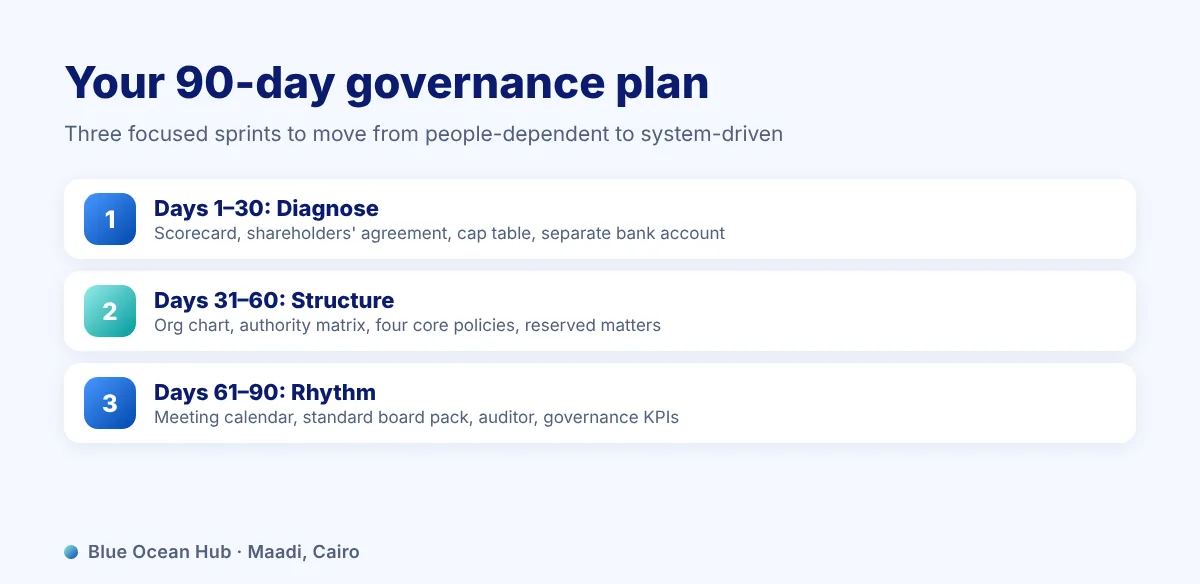
A 90-day plan to put governance in place
Days 1 to 30: diagnose and agree
- Run the scorecard below with all partners and agree on the gaps.
- Draft or update the shareholders' agreement and the cap table.
- Open or clean up a separate company bank account.
Days 31 to 60: structure and policies
- Publish the organisation chart, job descriptions and a delegation-of-authority matrix. Our article on business management systems covers the operating side.
- Write four short policies: conflict of interest, procurement, HR and data protection.
- Define reserved matters for the board or partners.
Days 61 to 90: rhythm and measurement
- Set a fixed calendar of board or partner meetings with a standard pack: P&L, cash, pipeline, risks, KPIs.
- Appoint or brief the external auditor and assign the audit-committee role.
- Track governance KPIs: meetings held on time, decisions minuted, audit points closed, authority-matrix breaches. Pair them with operational metrics as described in operational process improvement.
A professional setting helps the rhythm stick. Holding board meetings in a quiet, fully equipped meeting room with a screen and a written agenda changes the tone of the discussion more than most founders expect.
Corporate governance scorecard
Give one point for each "yes":
- Signed, current shareholders' agreement
- Company finances fully separate from personal finances
- Written delegation-of-authority matrix
- Regular board or partner meetings with signed minutes
- Annual audit by an independent auditor
- Organisation chart and job descriptions for all roles
- Written conflict-of-interest policy
- Monthly KPI review
- Agreed plan for a partner exit or a key manager's absence
- An independent voice in major decisions
8 to 10: solid foundation; focus on measurement. 4 to 7: partial governance with gaps that will surface during fundraising or expansion. Below 4: the company runs on people, not systems, and is exposed to the barriers to growth that stall many Egyptian SMEs.
Frequently asked questions
What is corporate governance?
It is the system that defines the relationship between a company's shareholders, board and management, and sets how decisions are made, monitored and held to account.
What are the characteristics of good corporate governance?
Discipline, transparency, independence, accountability, responsibility, fairness and social responsibility.
What are the main corporate governance mechanisms?
Internal mechanisms such as the board, committees, policies and internal audit, and external mechanisms such as the external auditor, regulators, lenders, investors and market pressure.
What does an audit committee do?
It reviews financial statements before approval, oversees internal and external auditors, and checks the effectiveness of internal controls and risk management.
Is corporate governance mandatory in Egypt?
Detailed rules are mandatory for listed companies, banks and non-bank financial firms. Other companies must meet the legal minimum under the Companies Law, while broader best practice is voluntary but expected by investors and lenders.
How can a small company apply corporate governance?
Start with a shareholders' agreement, separate finances, an authority matrix, monthly minuted meetings and an independent auditor, then add structure as the company grows.
Get governance right with Blue Ocean Hub
Blue Ocean Hub's business setup and growth consulting team helps startups and family businesses in Maadi and across Cairo diagnose their governance, design organisation structures, write practical policies and build KPI systems that fit their size. Still at the beginning? Read our guide to company formation in Egypt so you choose the right legal form from day one. Book a diagnostic session with our team.