Entrepreneurship is the process of spotting a problem or opportunity, building a business that solves it in a way customers will pay for, and taking on the risk that comes with it. An entrepreneur is not defined by how much money they start with but by how they turn an idea into something people value. To start your own venture, you move through a simple sequence: pick a real problem, test your solution cheaply, design a business model, plan your finances, register the right legal entity, and surround yourself with a team, workspace and network that help you grow.
This guide unpacks what entrepreneurship really means, clears up some persistent myths, explains the main types of entrepreneurship, looks at why it matters for Egypt, and gives you a practical first-100-days plan for launching with limited resources.
What entrepreneurship means
The word comes from the French entreprendre, "to undertake". In modern economics, entrepreneurship is the act of creating a new venture, or reinventing an existing one, by combining an idea with capital, people and resources, and managing the uncertainty involved in order to create value that did not exist before.
The key word is value. A venture does not succeed because it is new; it succeeds because it solves a problem for customers who are willing to pay. That value may be a lower price, a faster service, a better experience or access for a group nobody was serving.
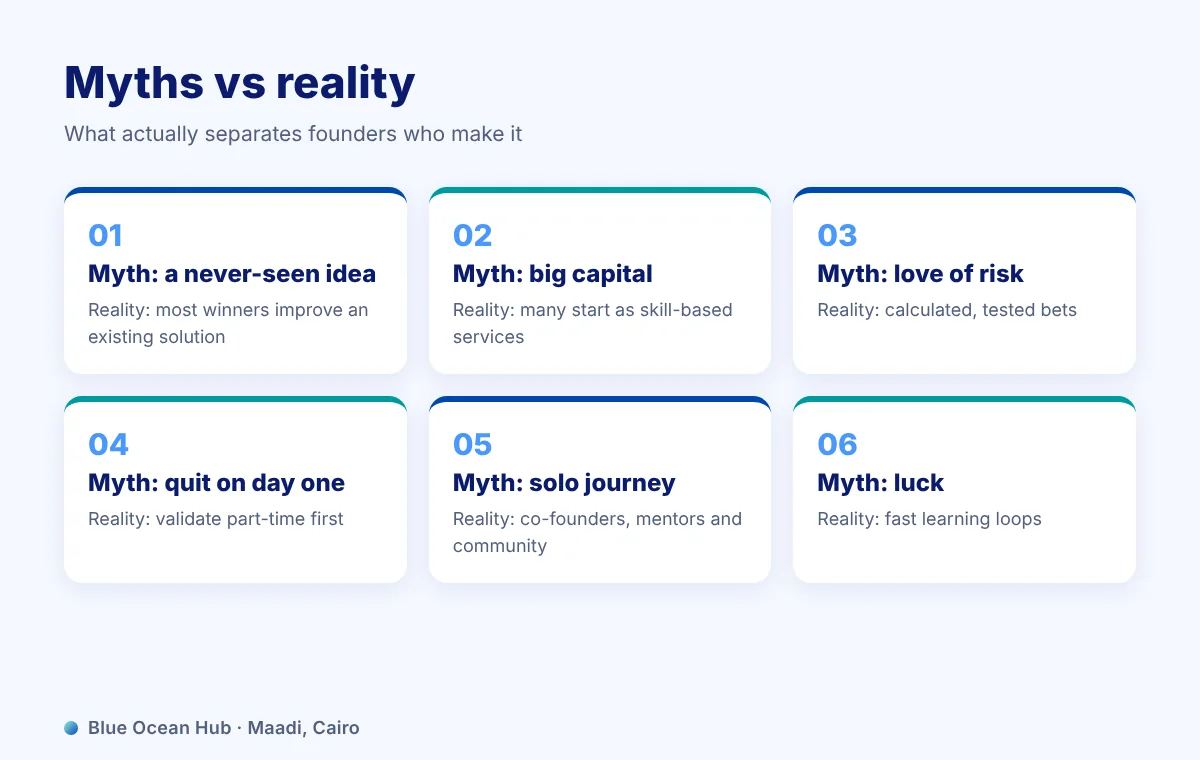
Five myths about entrepreneurship, and the reality
The entrepreneurial mindset
There is no single entrepreneur personality, but certain habits show up again and again, and all of them can be learned:
- Problem obsession: seeing everyday frustrations as opportunities rather than complaints.
- Calculated risk-taking: making bets, but small, measured ones first.
- Learning speed: changing course quickly when the evidence says you are wrong.
- Resilience: continuing through the months when results are slow.
- Selling and storytelling: convincing customers, partners, investors and hires.
- Resourcefulness: achieving more with less, especially early on.
- Relationship building: knowing that most opportunities come through people. Our article on the network you already have explores this.
Entrepreneur vs small-business owner
The two overlap, but they usually start from different places. An entrepreneur starts from an unmet need and builds something new or significantly different, often aiming for rapid growth. A small-business owner usually runs a proven model, such as a neighbourhood workshop or shop, aiming for stable income and gradual growth. Neither is better; economies need both. What matters is knowing which path you are on, because funding, planning and management differ.
Types of entrepreneurship
- Small-business entrepreneurship. Ventures built to provide a stable income for a person or family: cafés, shops, agencies, freelance practices. Often self-funded. If you are considering independent work, see the most in-demand freelance fields.
- Scalable startups. Companies designed for fast growth, usually technology-led and funded through investment rounds. Egypt's startup scene has grown noticeably in fintech, e-commerce and logistics; meet some of the people behind it in five Egyptian founders worth watching.
- Social entrepreneurship. Ventures whose main purpose is solving a social or environmental problem while earning enough to sustain themselves.
- Intrapreneurship. Entrepreneurial projects run inside established companies by small teams with startup-style freedom.
- Digital entrepreneurship. Businesses built entirely online, from e-commerce to content and software, with low start-up costs and access to clients abroad.
Why entrepreneurship matters for Egypt
- Jobs: small and medium enterprises are among the largest employers in the Egyptian economy.
- Innovation: new ventures push incumbents to improve products and prices.
- Diversification: new sectors reduce reliance on a few traditional income sources.
- Investment and exports: startups attract international capital and sell services abroad, bringing in foreign currency.
- Local development: ventures bring better services to cities and governorates that were underserved.
The build-measure-learn loop
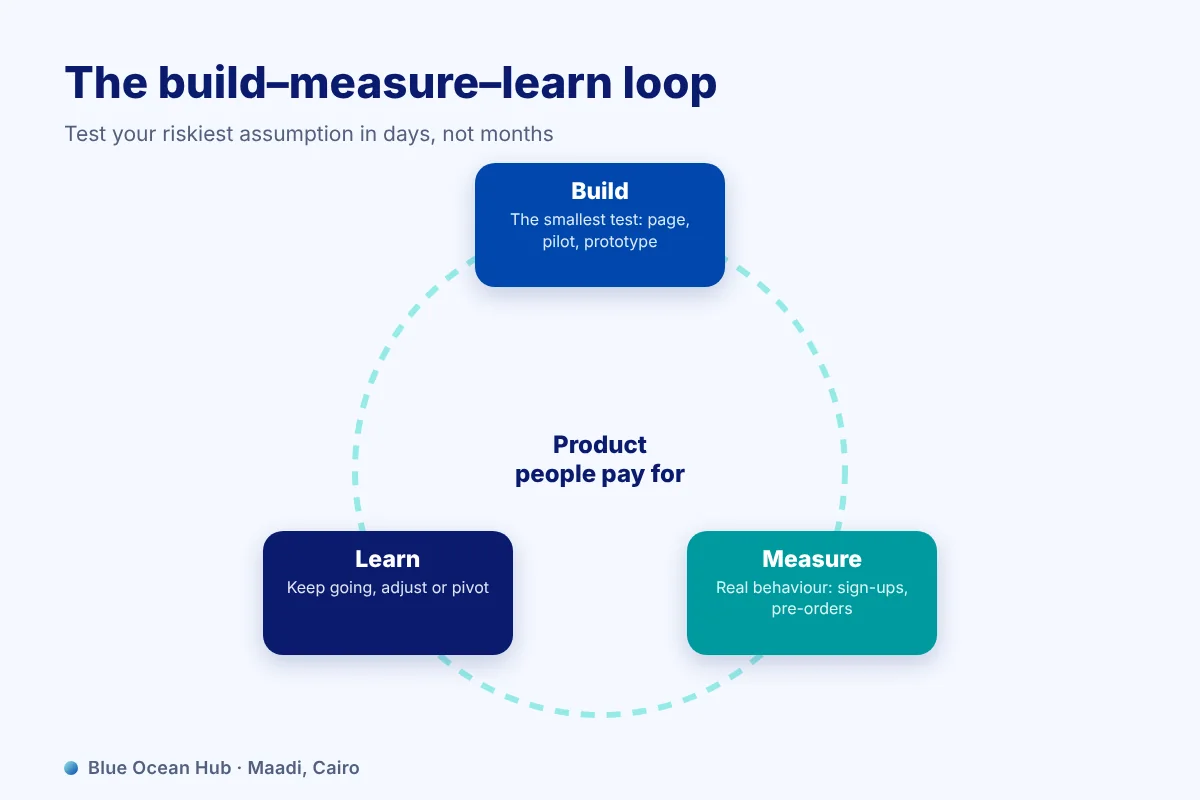
The most practical way to reduce risk is to treat your plan as a set of assumptions and test them in short cycles, an approach popularised by the Lean Startup method:
- Build the smallest version of your solution that can test your riskiest assumption: a landing page, a manual service, a prototype.
- Measure real behaviour: sign-ups, pre-orders, repeat purchases, not compliments.
- Learn and decide: keep going, adjust the offer, or change direction.
Each loop should take days or weeks, not months. The goal is to reach a product people pay for before your savings run out.
Your first 100 days as a founder
Days 1 to 30: validate
- Write down the problem, the customer and your proposed solution in one paragraph.
- Interview at least 20 potential customers. Ask how they solve the problem today and what it costs them.
- Launch a simple test, such as a landing page or a manual pilot, and try to collect pre-orders or deposits.
Days 31 to 60: model and plan
- Sketch your business model on a Business Model Canvas: customers, value, channels, revenue, costs, partners.
- Run a feasibility study with break-even and a pessimistic scenario.
- Decide on funding: savings, partners, a small-business loan, angel investors, competitions or incubators.
Days 61 to 100: set up and launch
- Register the right legal entity; our guide to company formation in Egypt explains the options.
- Agree roles and decision rights with any co-founders and sign a founders' agreement. Light governance early prevents most founder disputes.
- Choose a workspace that keeps fixed costs low and puts you among other builders.
- Launch to your first paying customers and track a few simple metrics every week.
Funding options, stage by stage
Where your money comes from shapes your freedom, your obligations and how fast you must grow. These are the main sources available to founders in Egypt, roughly in the order ventures use them:
The golden rule: do not chase investors before at least one customer has paid you. Investors fund evidence, not ideas, and every piece of traction improves your valuation and terms. When you reach that stage, our field guide to raising your first $250K in Egypt walks through the preparation.
Starting with little or no capital
- Sell a service first. Consulting, design, development and training need skill more than cash.
- Pre-sell. Deposits fund production and prove demand at the same time.
- Turn fixed costs into variable ones. Use daily office rental or meeting rooms by the hour instead of a yearly lease.
- Keep an income stream until the venture covers your personal costs.
- Use the ecosystem. Incubators, accelerators, competitions and community events, including Blue Ocean Hub events, open doors to mentors and early customers.
Where your environment comes in
Working from home saves money but isolates you; a private office signed too early drains cash. A coworking space in Maadi sits in between: a professional base at flexible cost, next to freelancers, founders and experts who may become clients, partners or mentors. Research and member experience both point the same way, as we explain in how a shared workspace boosts productivity.
Frequently asked questions
What is entrepreneurship?
Identifying a problem or opportunity and building a venture that solves it profitably, while managing the risk involved.
What are the main types of entrepreneurship?
Small-business entrepreneurship, scalable startups, social entrepreneurship, intrapreneurship and digital entrepreneurship.
What skills does an entrepreneur need?
Problem solving, calculated risk-taking, fast learning, resilience, selling, resourcefulness and relationship building.
Why is entrepreneurship important to the economy?
It creates jobs, drives innovation, diversifies the economy, attracts investment and supports local development.
How can I start a business with no money?
Start with a skills-based service, pre-sell to validate demand, keep costs variable, retain an income stream and use incubators and community programmes.
What is the difference between an entrepreneur and a business owner?
An entrepreneur typically builds something new for an unmet need and aims for growth; a business owner often runs a proven model for stable income.
Build your venture at Blue Ocean Hub
Blue Ocean Hub in Maadi gives founders what they need under one roof: flexible memberships from a single day, private offices, meeting and training rooms, a professional community and regular events, plus business setup and growth consulting for feasibility, incorporation and structuring. Book a free tour and see the space and community for yourself.